Sedated by Heritage
A shift in tone bought a standing ovation in Munich. The demands, the leverage, and the terms of the relationship remained unchanged.

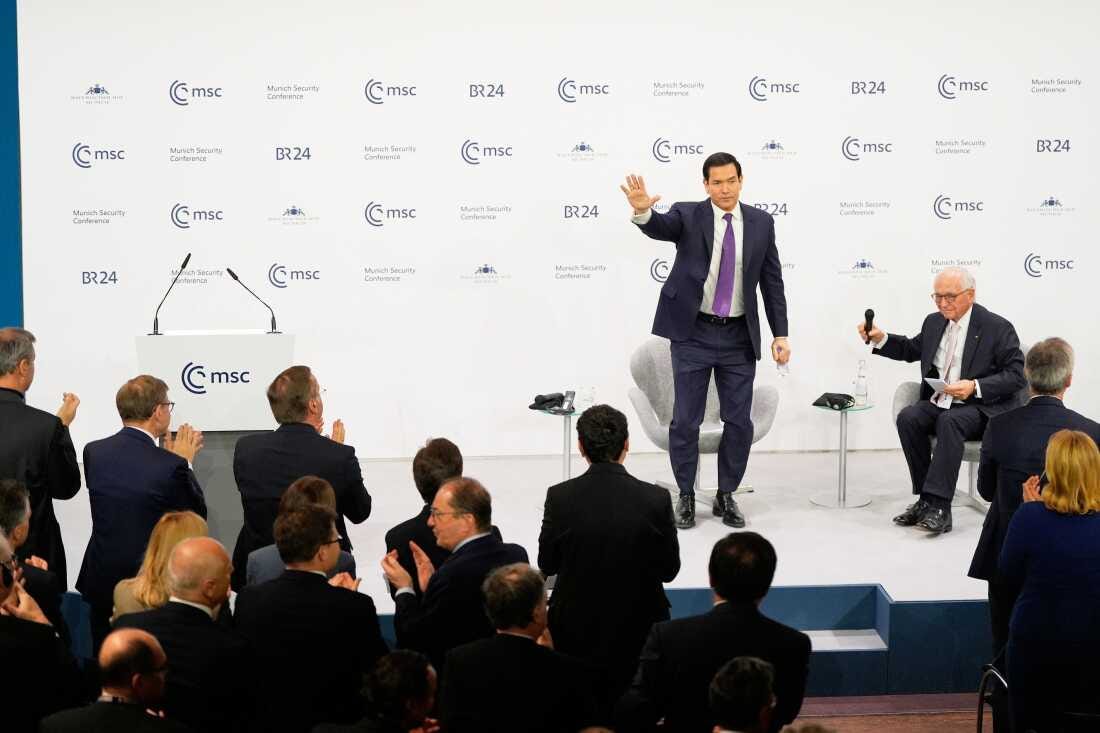
At the Munich Security Conference on Saturday, Marco Rubio told a room full of European heads of state that their climate policies amounted to a cult, that mass migration was eroding the cohesion of their societies, and that decades of their foreign and economic policy had been steering the West toward civilizational decline. The room gave him a standing ovation.
That ovation deserves more attention than the speech. The policy positions have been consistent for over a year — nothing Rubio said was new. What was new was the reaction. Europe’s senior political leadership, in full public view, collectively endorsed a speech that offered warmth without a single concrete concession on Ukraine, Greenland, trade stability, or the rules-based international order. The question is why.
The cognitive error the room made
Twelve months ago, Vice President JD Vance addressed the same gathering and accused European leaders of suppressing free speech, enabling censorship, and presiding over democratic decay. The audience recoiled. Commentators across Europe called it unprecedented. The shock was genuine.
Rubio delivered the same policy position. While his tone was more conciliatory, the core message remained intact: the West faces civilizational decline driven by deindustrialization, a "climate cult," and mass migration — all of which Rubio attributed to conscious policy choices by liberal leaders. He described deindustrialization as a "foolish, but voluntary transformation." The US national security strategy still treats European domestic policy as a threat to Western survival. Rubio never repudiated Vance's 2025 positions. The Greenland episode — in which Washington threatened tariffs against European allies to pressure Denmark over sovereign territory — went unmentioned. Not because the matter was settled, but because omitting it served the narrative of renewed goodwill.
What changed between Vance and Rubio was register, not content. European leaders misread the shift because the institutions they operate in default to hearing how something is said as a reliable signal of what is actually meant. When the tone softened, the room concluded that the relationship had improved. Matthew Syed calls this “cognitive homogeneity” — when a shared set of assumptions prevents a group from seeing what an outsider would immediately recognize. Munich on Saturday was a textbook case. The collective assumption — softer tone means changed policy — went unchallenged because every senior official in the room shared it.
European officials later admitted as much: Vance’s aggression in 2025 had been easier to handle because it ensured unity in response. Rubio’s courtesy was more disorienting — it made the threat harder to see. The room’s own professionals were describing a vulnerability, not a strength.
European diplomats privately concluded that the speech was intended for a US domestic audience rather than for allied leaders. Rubio offered reconciliation on Washington's terms, positioning European policy reform as a precondition for continued partnership. Yet the room stood.
Honest reflection demands that senior officials and the advisers around them confront the gap between private skepticism and public performance. The diplomats knew. They stood anyway.
Relief is not a strategy
This pattern operates well beyond diplomacy. Institutions under sustained pressure from a more powerful party grow oversensitive to emotional signals. The weaker party begins to calibrate its own confidence not against objective conditions, but against the emotional register of the stronger party. When the stronger party signals displeasure, anxiety spikes; when it signals warmth, the system exhales — regardless of whether the underlying demands have changed.
The conference chair himself captured this dynamic, telling Rubio from the stage that the room had breathed a collective sigh of relief. German Defence Minister Pistorius compared the alliance to a marriage in crisis but said the tone signalled a willingness to face challenges together. European Commission President von der Leyen called the speech “very reassuring.” EU foreign affairs chief Kaja Kallas described the overall message as one of continued unity.
In geopolitics, as in any organization, atmosphere is what you feel, and structure is what constrains your options. These responses assessed the former. Not one assessed the latter.
Rubio did not use the hyperbolic language favoured by the Trump administration — which has previously referred to Europeans as weak and decaying — but the core message stayed intact. The underlying demands — that Europe adopt Washington’s positions on immigration, climate, defence spending, and industrial policy — remained exactly where they were.
Let us say this more plainly than European diplomatic circles tend to allow: relief felt in a conference hall is not a negotiating position. A standing ovation offered in gratitude for a softer register is not a strategic response. The content that was applauded warrants scrutiny on its own terms. Rubio quoted “civilizational erasure” — language drawn directly from the American national security strategy that pledged to support Europe’s far-right movements. He eulogized colonialism as a shared heritage and framed Western civilization as superior to others. European leaders stood and applauded. The ovation was not just strategically incoherent. It was ideologically compliant — and the room either did not notice or chose not to.
The civilization frame and what it conceals
Rubio anchored his entire address in the language of “Western civilization.” He cited Mozart, Dante, Shakespeare, the Beatles, and the Rolling Stones. He framed the challenges ahead as a quest to rescue an entire civilization from decline — positioning the transatlantic bond not as a strategic partnership but as a shared cultural inheritance requiring joint defence.
Look closely, and you'll see that this framing does something specific and consequential. It collapses twenty-seven EU member states — each with distinct institutions, political traditions, and ways of governing — into a single nostalgic narrative. The consensus-building traditions strong in Nordic governance, the personal relationships and informal trust that drive Southern European diplomacy, the procedural thoroughness that defines how Germany governs, France’s strategic insistence on acting independently, the post-communist memory politics of Central and Eastern Europe — none of these is a fixed national character. Each reflects choices made under distinct historical pressures. All of them disappear inside a generalized appeal to “our civilization.”
“Child of Europe” does not describe a strategic relationship — it claims belonging through descent, and descent requires selecting an ancestry and sounding like the one-drop rule in my view. Rubio’s was colonial, Christian, and culturally singular: Mozart, Dante, Columbus, but not the societies Columbus encountered, not the Afro-Caribbean musical traditions without which the Beatles and the Rolling Stones he cited would not exist, not the post-colonial, multilingual, internally contested continent that European leaders actually govern every day. He assembled a lineage and offered it as the whole inheritance — and that assembly quietly determines who belongs to “our civilization” and, by silence, who does not. Leaders whose own populations include the communities this framing erases stood and applauded it. They either failed to hear what was being excluded or heard it and decided it did not matter enough to remain seated.
Anyone who has negotiated across European capitals should recognize this flattening for what it is: a professional warning. The fact that Europeans govern differently from one another is a structural strength. When a senior US official reduces the continent to a curated list of cultural achievements and then prescribes a single set of policy corrections, what follows is not an alliance conversation. What follows is a compliance request dressed in shared heritage.
The distinction matters because it shifts where the alliance draws its authority from. The speech moved the transatlantic bond away from what Europeans actually built together — multilateral treaties, negotiated rules, shared institutions — and placed it on heritage instead. In doing so, it quietly shifted Europe’s role from co-architect to beneficiary. A civilization can be celebrated. A civilization can be mourned. But a civilization does not negotiate. Only institutions negotiate. And Europeans spent decades building the institutions that gave them a seat at the table precisely because they understood this.
The responses that did, and did not, set a different frame
Macron, addressing the conference the previous evening, attempted to establish a counter-narrative. He urged Europeans to reject the caricature of a continent in decline and pushed back directly on the charge that Europe was, as he put it, “an aging, slow, fragmented construct sidelined by history.” He insisted that the world should take its cue from Europe rather than criticize it. He proposed a new strategic dialogue on nuclear deterrence and called for Europe to become a geopolitical power in its own right.
Merz opened the conference by identifying a deep rift between Europe and the United States and arguing that even Washington cannot operate effectively unilaterally in an era of great power competition. He drew a clear line: Europe would not import American culture wars, would maintain its commitment to the WHO and climate agreements, and understood that freedom of speech ends where human dignity begins.
Zelensky, speaking after Rubio, said that only the United States has the power to pressure Russia into ending the war — a stark acknowledgement of the power asymmetry that hung over every exchange in Munich. The contrast between Ukraine’s operational urgency and the halting, uneven pace of Europe’s collective response was difficult to miss.
These were substantive positions from Macron and Merz. They also revealed the depth of the problem. European leaders are producing strong rhetoric about strategic autonomy and self-reliance, while simultaneously offering standing ovations to a speech that told them their value system is the source of their decline. That contradiction weakens every negotiating position the continent attempts to hold, because the other side can see the gap between what Europe says to itself and what it performs when Washington is watching.
Honest engagement with the European project demands something more uncomfortable than analysis. The question is not whether Europe can articulate a different vision. Macron and Merz demonstrated that it can. The question is whether that vision can hold when the room fills with emotion, and the pressure to perform gratitude becomes overwhelming. So far, the evidence suggests it cannot — because Europe’s dominant diplomatic instincts still default to reading tone as intent and performing unity in public even when the private assessment points the other way.
What the ovation should have been
None of this means European leaders should have responded with hostility. Diplomatic engagement with the United States remains essential. Away from the main stage, serious and detailed work continued on defence procurement, NATO reform, and security guarantees. Officials had not surrendered to fatalism. The practical machinery of the alliance kept turning.
The problem was not the engagement. The problem was the ovation — a collective, emotional endorsement of a speech that offered kinship without commitment and heritage without partnership.
A more strategically coherent response would have been polite, measured applause — and a press conference afterwards that calmly identified the gap between the speech’s tone and the administration’s unchanged policy positions. Not confrontation. Calibration. The kind of precise public signalling that any experienced diplomatic adviser deploys when acknowledging a gesture without endorsing a frame.
Former Lithuanian Foreign Minister Gabrielius Landsbergis offered one of the few unvarnished public assessments: the speech represented no departure from the administration’s established position — the same message had simply arrived in more polite packaging. That observation deserved a wider hearing than it received.
The real question Munich left unanswered
The most important question after Munich is not whether the transatlantic alliance will survive. Alliances between major powers endure because the alternatives are worse. The question is whether the clearer-eyed reading already present in parts of Europe — visible in Landsbergis’s assessment, in Baltic and Nordic strategic clarity — can gain ground in the EU’s dominant institutions before the next round of negotiations arrives.
For seventy years, the transatlantic partnership ran on a common institutional operating system: rules-based order, multilateral coordination, and a shared belief that tone and substance were broadly aligned. The current US administration has replaced that operating system. It operates on transactional logic, where tone is a tool, heritage is a bargaining chip, and alliances are valued by their compliance, not their history.
Each year, Munich convenes to hear European promises to act with greater urgency. Each year, startling rises in defence spending seem nearer but fail to close the gap between rhetoric and strategic autonomy. At next year’s conference, Starmer’s government may be in difficulty, France will face presidential elections, and the Trump administration will have weathered the midterms. The window for Europe to define its own terms is not closing gradually. It is closing now.
The diplomats, policy advisers, and EU officials who manage these processes bear a specific obligation in this environment: to distinguish between a softer register and actual grounds for confidence.
Munich offered a masterclass in what happens when that distinction collapses. The speech was polished. The applause was heartfelt. And the terms of the relationship remained exactly where they were before the first word was spoken.
The standing ovation was the story. Almost nobody reported it that way. And the leaders who stood? They will return to their capitals, brief their staffs, and prepare for the next round of negotiations, having already shown Washington exactly how little it costs to buy their applause.
Europe does not have a strategy problem, but it definitely has a dignity problem. Until its leaders stop expressing gratitude for being addressed politely while the terms of their subordination remain unchanged, no amount of defence spending, strategic autonomy rhetoric, or conference communiqués will alter the dynamic. The other side of the table is watching. And it learned exactly what it needed to learn on Saturday.
Cultural Currents is a governance newsletter exploring how Cultural Intelligence shapes policy, public administration, and intergovernmental affairs across Western and Southern Europe.